Hog Wild….Cochon 555 comes to Denver

Save the pigs…eat them! I’m headed to Cochon 555 Denver at the Ritz-Carlton this Sunday, April 3, for Kitchen Raised – eating, drinking and writing my way through a pig lover’s paradise.

Five Colorado chefs: Alex Seidel of Fruition Restaurant, Denver; Kelly Liken of Restaurant Kelly Liken, Vail; Frank Bonanno of Osteria Marco, Denver;  Lachlan Mackinnon of Frasca Food and Wine, Boulder; and Jennifer Jasinski of Rioja/Euclid Hall, Denver will take part in a friendly competition preparing a five 175-pound heritage breed hog from head to toe.

Head to toe cooking is not a new concept. It is however, becoming more well-known as butchers, chefs and consumers are looking for ways to waste less and bring new tastes to the table. By consuming heritage breed hogs, the demand for these animals will go up, helping farmers continue the animal’s bloodlines and continue providing for the consumer.

The breeds we’ll taste on Sunday are Swabian Hall, Hereford, Berkshire, Mulefoot and Red Wattle. I have never tasted heritage pork before, so the information I am presenting to you is based on what Cochon 555 provides on their website.

Later this week, I will be talking to Shannon Duffy of Tender Belly, the company providing all the pigs for this Sunday’s event. Shannon and his brother, Erik, are Berkshire pork purveyors and make some amazing bacon! I can’t wait to share with you what Shannon has to say about this event.

Swabian Hall is a breed from Germany and has a good reputation among foodies for its dark meat and a strong distinct flavor.

The Hereford breed is rare, but also well-known. These hogs resemble Hereford cows, with a reddish brown coat and white face. Herefords are known for their calm dispositions and their ability to thrive in pastures. It is a slower growing breed, and yields a rich colored marbled meat.

Berkshires come to us by way of Britain, and are the most popular of the heritage breeds. It is a black pig with white legs and is known as “Kurobuta” in Japan, and is a favorite breed among chefs because of its intramuscular marbling. The meat is brighter than most others and features a thick, delicious fat cap. (Um, is anyone hungry yet?) The meat is sweet and creamy with hints of nuttiness.

The critically rare Mulefoot breed is a black hog named for its solid hoof, like a mule. The Mulefoot recently won a blind taste test against eight different heritage breeds. The Mulefoot’s disposition is docile, and its weight gain is between 400 and 600 pounds before age 2. This breed is known for its premium hams and superior tasting meat, which is red with freckled marbling.

Last but not least is the Red Wattle, named for its red color and the fleshy skin that hangs under its jowl. This extremely rare breed adapts to climates well and is an excellent forager. Prized for its tender meat and hams, the Red Wattle is lean and juicy with its meat’s texture and taste similar to beef.

Attendees will get to sample pork dishes from the chefs as well as wines from five wineries. They’ll also get to help choose the “King or Queen of Porc”, watch a whole pig breakdown demonstration, and taste a whole roasted heritage breed pig and dessert.

Brady Lowe, event founder said, “…Pork-avores from Washington, D.C., to San Francisco get a chance to discover incredible breeds of pigs and family-run wineries.” Lowe created the event in response to a lack of consumer education around heritage breeds. He believes that by educating the consumer about heritage breed pigs, they’ll in turn make more-informed decisions around food purchasing and their overall health.

If you love pig – and all of you bacon freaks know I’m talking to you, then this is your event. Tickets to this Sunday’s event are $125. If you’re interested, purchase tickets here.

 

What’s In a Name?

I hope you’ve noticed that I changed the name of my blog. “Lia’s Blog of Big Eating” is now “Kitchen Raised”. I’ve been toying with a name change for quite some time now. I liked what the original name evoked…me and my culinary adventures, bigger is better, etc. I am not always a big eater and not always in your face and louder than life. That name doesn’t speak to my attitude in the kitchen – my kitchen, my parents’ kitchen or your kitchen.

I try to be methodical and build on what I’ve learned in the past to create memorable meals for the present and future. I know I’ve mentioned this before, but I really was raised in the kitchen.  I am one of five children and we were required to help out – only if we wanted to eat – and speaking from experience, I know it’s why we all can hold our own in the kitchen.

I grew up hating asparagus. I did not get how anyone could enjoy it. I couldn’t even say the word “asparagus” without gagging dramatically, which my parents thoroughly enjoyed. Enter my mid-20s. My mom started roasting asparagus in the oven, sprinkling it balsamic and shaved parmesan. Now I would gladly eat asparagus every day if I didn’t think it was unfair to other vegetables.

As kids, we learned how to clean and prepare vegetables, make an omelet and frost a cake. We learned menu planning and time management (still not so great at that) and important things like how to cook pasta and meat thoroughly. We accompanied my mother on trips to the grocery store and farmers’ markets.

As adults, we drink from my parents’ vast wine collection and peruse my mother’s ever expanding cookbook collection. When I go to mom and dad’s, I toss my belongings wherever, rarely hanging up my jacket and head straight for the fridge. Much to my parents’ chagrin, I’ll stand with the refrigerator agape and demand; “Do we have anything to eat?” before rummaging through blocks of cheese, hard salami and whatever else I can get my hands on. Sitting at the kitchen table, the same table I’ve eaten family dinners at for years, I’ll read Julia Child, Thomas Keller, and Mario Batali and drink too much wine. This is home.

I hope you understand the name change – it speaks the knowledge I’ve gained as someone who seeks out the kitchen in every home I visit and my desire impart the joy of cooking to my readers. Thanks for joining me.

As always, please feel free to comment or ask questions.

Feeding Hungry Masses: Lasagna

I’ve been making lasagna for years. It’s a dish I grew up with; it made frequent appearances at our dinner table and was a good standby at potluck dinners. I don’t know if I ever asked for a recipe from my mom, or after watching her make it countless times I just figured it out.

It’s great for Sunday dinner because you will inevitably have leftovers – unless you’re really hungry or feeding a crowd – and it’s nice to have at least one planned leftover for the week.

My friend Justin has been asking me for months to teach him how to make lasagna. I can’t remember the origins of the conversation, but I suspect it has something to do with him perhaps not entirely believing I can cook.

Regardless, I did promise the guy I would show him how easy it is to make the most comforting, cheesy deliciousness that is lasagna. After some back and forth, we settled on a date and he even wrote it in his calendar. And I doubted his commitment to cooking.

Before Justin and his entourage of hungry men came over, I had a slight panic attack. I’ve never written down a recipe for lasagna. I just wing it. And it turns out wonderful each time. I come from the “It’s hard to mess up a pot of Bolognese” school of thought, but still, I knew he would need a recipe.

I trolled the Internet for lasagna recipes; I needed to know that what I had cobbled together by memory was pretty close to what epicurious.com and the Food Network would show me. I pick those two websites, not because I like their recipes all that much, but it’s easy to find basics and build from there. I was on the right track, or at least close enough. A couple of recipes called for cottage cheese instead of ricotta. Now, I am no culinary purist by any stretch of the imagination, but that is something I will not use in lasagna. You can if you want to. I believe that ricotta has a smoother, richer taste. And yes, you can purchase low fat ricotta and the lasagna will still be delish.

I also consulted the new edition of “The Joy of Cooking”, and found its recipe for Bolognese Sauce to be superior to what I planned to use. I didn’t have pancetta in the house; otherwise I would have considered using it. But my worry slowly subsided. I’ve made the roughly the same “recipe” when I’ve made lasagna for years. No one has ever complained that it wasn’t meaty or cheesy enough. If anyone hasn’t liked it, they’ve never told me.

I called my friend Stephanie over, as I put it, “I may need you to regulate. I have no idea what to expect.” She arrived with two beers in hand.

As someone who cooks alone more often than not, it was fun to have a noisy kitchen. Justin is an easy student, albeit slightly demanding. If I tried to scoot in front of him to check on the sauce’s progress or mix the cheese and eggs, he’d say, “Hey! Aren’t I supposed to be doing this?!”  And he says I have a Type A personality…

The lasagna was a hit and Justin proved that he’s no slouch in the kitchen. For those of us who do cook, there is a prideful feeling we get when we teach someone how to make something we love.

Lasagna

Ingredients:

1-1/2 pounds ground beef

1 pound hot Italian sausage, casings removed

2 cloves garlic, minced

1 28-ounce can of whole tomatoes

2 6-ounce cans tomato paste

4 tablespoons dried parsley, divided

2 tablespoons dried basil

1 teaspoon salt

3 cups ricotta cheese

2 whole eggs, beaten

½ cup Parmesan cheese (grated or shredded)

2 cups fresh baby spinach, optional

1 pound mozzarella cheese, grated

12 lasagna noodles, cooked al dente

Bring a large pot of salted water to a boil.

In a large skillet, or saucepan, combine ground beef, Italian sausage (remove from casings) and minced garlic. Cook over medium-high heat until browned. Drain ¾ of the fat. Add tomatoes, tomato paste, parsley, basil and salt. Mix well and turn down heat to medium low. The sauce should simmer for about 30-35 minutes.

Add lasagna noodles to boiling water and cook until al dente, about 7 minutes. Strain noodles. If you would like, you can sprinkle the noodles with a small amount of olive oil to prevent sticking. Otherwise, just hang the noodles over the edge of the colander.

In a medium bowl, mix ricotta, beaten eggs, Parmesan, remaining parsley and 1 teaspoon salt. Mix with a wooden spoon or rubber spatula. Gently stir in baby spinach, if you’re using it.

Preheat oven to 350°F.

To assemble:

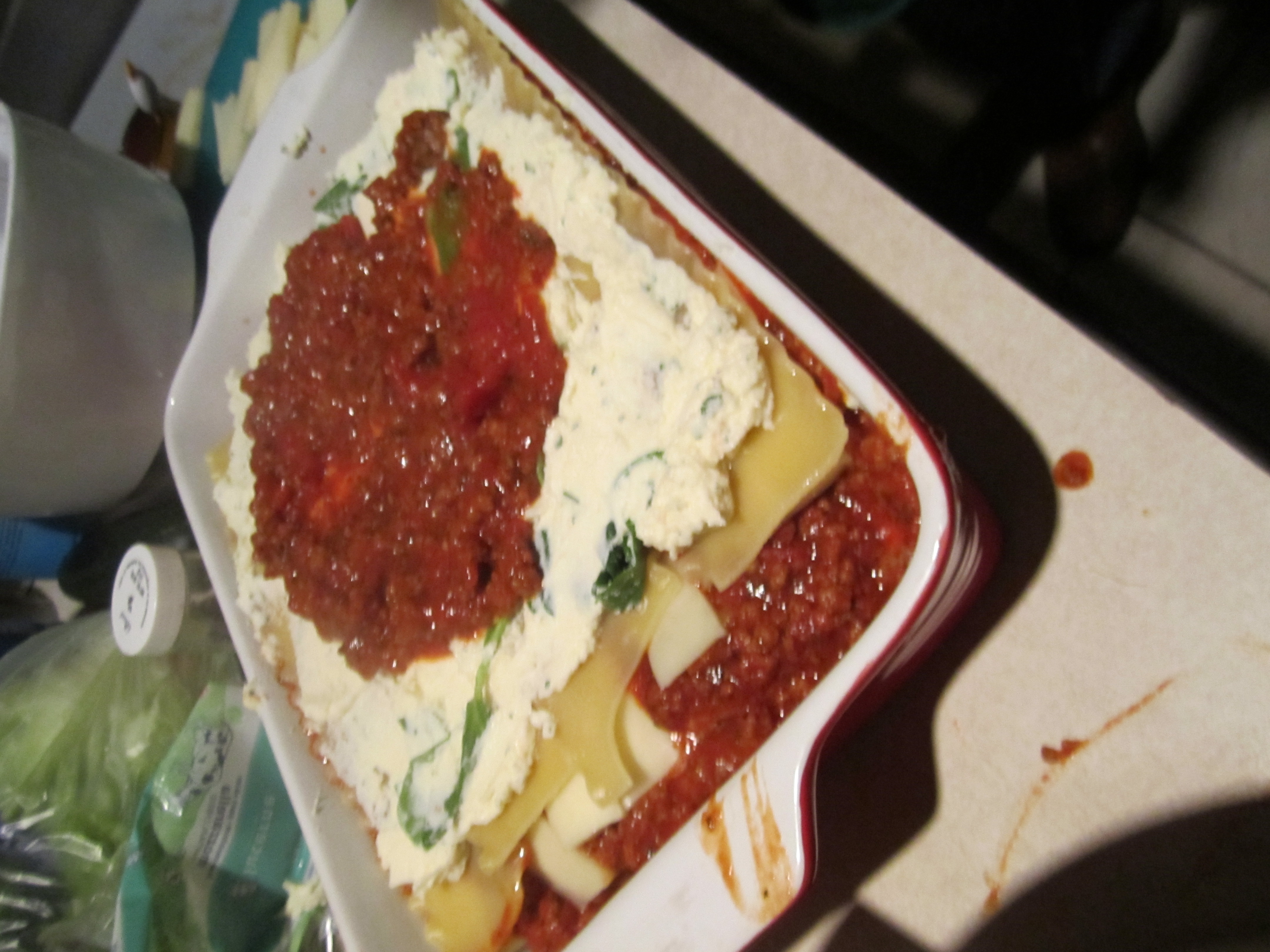
Arrange 4 cooked lasagna noodles in the bottom of a 9 X 13 baking pan, overlapping if necessary. Spoon half the cheese mixture over the noodles. Spread evenly. Spoon a little less than half of the meat sauce on top of the ricotta. Next, sprinkle a layer of grated mozzarella. (Note: we used sliced mozzarella based on the recommendation of someone who shall remain nameless. Either pony up the cash for grated mozzarella or use a grater. A food processor will get the job done nicely, too.)  Repeat steps, ending with meat sauce mixture. Sprinkle generously with extra Parmesan.

Bake for 30-35 minutes, until the top is hot and bubbly. Let stand for 15 minutes before you serve it.

Justin browning beef and Italian sausage.

Cheese, meat and pasta...yum.

Hot bubbly goodness. Let it sit for about 15 minutes so it all sets up. It's worth the wait!